
Most Business Review programmes lean heavily on the score: it gets featured in the slide deck, tracked over time and used as headline evidence that the relationship is moving in the right direction. The comment that came with it often gets skimmed once, checked for anything urgent, then left out of the review itself. That's not because it matters less, it's because it can be harder to work with at scale. Getting more consistent about using both is what makes a Business Review feel evidenced rather than generic.
Numbers & comments tell different parts of the same story
A score gives you something a comment can't: a consistent, comparable measure across accounts and across quarters, helping you track sentiment trends and spot movement early. What a comment adds is the context behind that number. Two customers can give the same score for entirely different reasons, one because a project went smoothly, another because confidence has been quietly slipping and this is where it's settled. Read on its own, the score can't tell those two apart.
Written comments also tend to surface things that don't show up in a number at all:
- A specific person who's making the relationship work
- A process or handover that's causing friction
- A competitor the customer has mentioned
- An expectation that wasn't met, even where the score stayed steady
Neither the score nor the comment gives the full picture by itself; you need to include both.
Bringing quantitative & qualitative feedback into the review
- Read every comment, not just the detractors. It's common practice to filter written feedback for low scores that need a response, which helps with the first assessment of feedback, but you shouldn't stop there. Promoters and passives write useful comments too, often the ones pointing to a growth opportunity or a compliment worth passing back to the team involved. If comments only get read when something's gone wrong, the review ends up telling a lopsided story.
- Group comments into themes before the review. A single comment is an anecdote, but the same theme appearing across several responses, or the same account over several quarters, is a pattern worth building a conversation around. Grouping written feedback into a handful of themes like communication, responsiveness, pricing or a specific service line, turns it from a formality into something structured enough to sit alongside the score.
- Bring the actual words into the room. Referencing a comment directly, even briefly, shows it was read in a way a score movement alone can't. "You told us X last quarter, here's what we did about it" is a stronger opening than a trend line on its own. It also signals to the customer that their feedback is read and used, which tends to improve the quality and honesty of future responses.
- Track themes over time, alongside the score. A recurring theme from customers, even those who score well, is sometimes an earlier signal of risk than a dip in the number. Keeping a record of recurring themes alongside the score gives Account Managers a fuller account of the relationship to bring into the next Business Review.
Keep it consistent across every account
Tracking written feedback across a wide portfolio is challenging, where hundreds of written responses can arrive every review cycle and manually reading and categorising all of them isn't realistic. Clientshare's own research, The QBR Frustration, found that only 38% of suppliers have full visibility of customer feedback and account health across all of their accounts, with 28% lacking visibility across most or all of them. Scores are relatively easy to keep visibility of at scale because they can be trended automatically, but comments are usually the first casualty of that gap, as they're harder to digest at a glance.
This is where technology can support account teams, not by replacing the read-through of comments, but by making it possible to do consistently across every account. This is where Clientshare comes in.
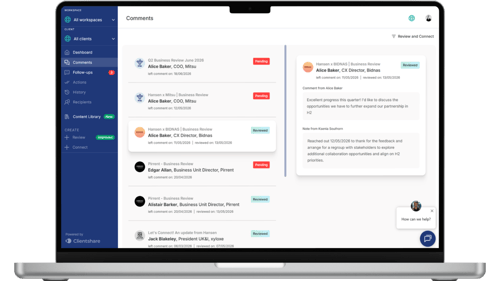
Clientshare's platform brings every comment, score and action into one place in real time, with alerts on new responses and progress tracked through to resolution, so following up on what a customer wrote isn't left to whoever remembers to check.
AI then handles the reading and interpretation at scale: identifying key themes across written feedback, detecting changes in sentiment across every account, and highlighting or forecasting the ones at risk, so Account Managers get the pattern without having to read every comment line by line themselves.
Final thoughts
A Business Review built on both the score and the comment gives a fuller, more evidenced account of the relationship than either can on its own. Building a habit of reading, grouping and referencing what customers write, alongside what they score, is a small change that makes the review feel less like a report and more like a conversation the customer recognises they had.
---
Read more