For many suppliers, mixed feedback can feel difficult to present. A single average score looks cleaner in a Quarterly Business Review (QBR), but different scores are not a problem to hide. In many cases, they are where the most useful insight sits.

The value of NPS in B2B services is not just understanding whether a customer would recommend you. It is understanding where confidence is strong, where sentiment is weakening and where action is needed next.
For many suppliers, the challenge is not whether these reviews matter. It's deciding which customers need a full strategic review, which need a simpler engagement model and how to keep every relationship visible without overwhelming account teams.
One account can contain more than one customer experience
A common mistake in B2B customer feedback is treating an account as though it has one shared opinion.
That might work in simpler customer relationships, but it becomes risky when you are managing large, multi-stakeholder contracts. Senior leaders may care about value, innovation, governance and risk, operational contacts may care about responsiveness, consistency and issue resolution, and procurement teams may care about commercial performance and evidence of return.
All of those views matter, and they may not line up neatly.

If your senior sponsor gives a high NPS score, but operational stakeholders give lower scores, the account may look healthy at the top while problems are building on the ground. If operational contacts are positive, but senior stakeholders are disengaged, you may have strong delivery relationships but weak executive visibility.
This is why suppliers should avoid relying too heavily on a single average score. As explored in Clientshare’s article on how senior leaders should use NPS benchmarks, NPS becomes more valuable when you view it in context, alongside wider relationship, account and performance data.
What mixed NPS scores can tell you
Different stakeholder scores can help account teams ask better questions.
Rather than simply asking, 'Is this a good score?', you can look at what the variation reveals:
-
Are senior and operational stakeholders experiencing the relationship differently?
-
Are detractors concentrated in one team, region or service line?
-
Are passives signalling quiet disengagement?
-
Are promoters showing what could be replicated elsewhere?
-
Are lower scores coming from stakeholders with high influence over renewal decisions?
This moves NPS from a reporting metric to an account health tool.
It also helps suppliers avoid a false sense of confidence. An average score may look positive, but still hide a small group of influential detractors. Equally, a lower score may be driven by one specific issue that can be fixed quickly if it is understood properly.
The goal is not to overanalyse every response, it's to understand the story behind the score.
How to use stakeholder-level NPS in your QBR
Bring mixed feedback into your Business Reviews constructively by framing them as a more detailed view of the relationship, instead of as a problem. For example:
“We’ve reviewed feedback by stakeholder group, which has helped us identify where the relationship is working well and where we need to focus next.”
This keeps the conversation positive, honest and action-led and shows the customer that their feedback has been taken seriously, rather than reduced to a single headline number.
A useful slide in your review might include:
-
Overall NPS score and trend
-
Response volume and stakeholder coverage
-
NPS by stakeholder group, region or service line
-
Key themes from written comments
-
Priority risks or opportunities
-
Actions agreed since the last review
-
New actions, owners and timings
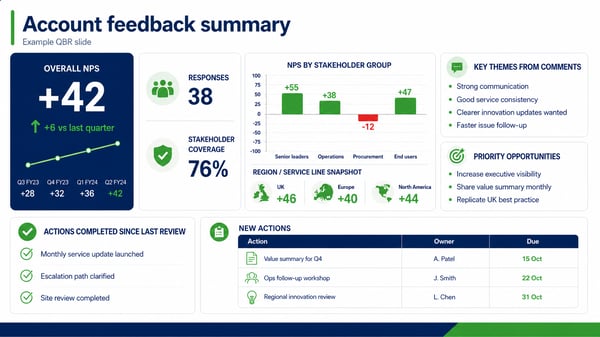
This links closely to Clientshare’s guidance on using NPS and CSAT insights in QBR decks. In short, scores are useful but they become far more powerful when they support a clear conversation about value, improvement and next steps.
Make sure the right stakeholders are included
If NPS scores vary across an account, it may also be a sign that your stakeholder engagement needs attention.
Ask yourself whether you're hearing from the right people? Are senior decision-makers engaged? Are operational teams represented? Are influential stakeholders giving feedback, or are they missing from the process entirely?
Strong stakeholder mapping helps suppliers understand who needs to be involved, what each group cares about and how review content should be shaped around them. The same principle applies to NPS as the more clearly you understand who the feedback has come from, the easier it is to interpret and act on it.
This is particularly important in complex customer relationships, where a small number of disengaged stakeholders can have a significant impact on renewal confidence.
Turn mixed feedback into targeted action
If different stakeholders are telling you different things, the action plan should reflect that. A generic improvement plan may not be enough.
For example, your action plans can evolve depending on if...
-
...senior leaders want stronger evidence of value, build a clearer value summary into the next Business Review.
-
...operational contacts are frustrated by issue resolution, agree a more visible escalation process.
-
...one region is less satisfied, arrange a focused review with the local team.
-
...passives are not giving detailed comments, follow up with a short question to understand what would move the relationship forward.
-
...promoters are highly engaged, use their feedback to identify best practice that can be repeated elsewhere.
This is where the feedback loop matters. Clientshare’s article on closing the feedback loop with your Business Reviews explains the importance of capturing feedback, assigning ownership, taking action and communicating progress back to the customer.
Without clear ownership, the risk is feedback ends up sitting in silos. But with clear ownership, it becomes a practical improvement plan.

Final thoughts
Different stakeholders won't always give the same NPS score and, in complex B2B relationships, they probably shouldn't.
Variation in feedback is not something to hide. It's a sign that you're hearing from different parts of the customer organisation, each with their own priorities, expectations and experience of the relationship.
When you look beyond the average score, you can see where confidence is strongest, where risk is emerging and where action is needed next. Most importantly, you can bring that insight into the QBR in a way that strengthens trust.
Because the best Business Reviews do not just report feedback. They show customers that their feedback has been understood, acted on and used to build a stronger relationship.
Read more:
.png?width=315&height=236&name=nps-whitepaper-thumbnail%20(2).png)