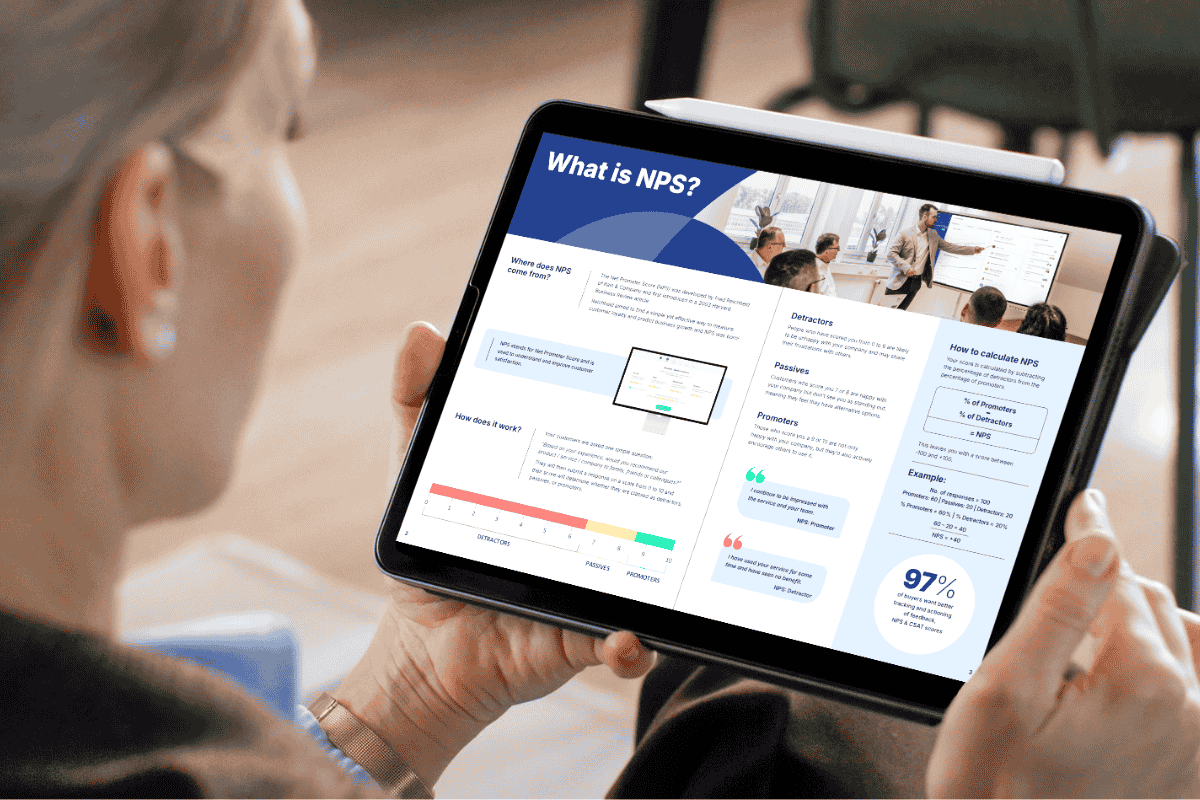
A good Net Promoter Score (NPS) in B2B services is one that sits above relevant industry benchmarks, improves over time and aligns with stronger customer retention, stakeholder engagement and account growth. There is no single 'good' NPS for every supplier, because performance depends on your sector, client mix, relationship maturity and the complexity of your customer accounts.
For senior leaders, NPS is most useful when it is viewed in context. A score of +35 may be strong in one B2B sector but underwhelming in another. It may also hide major differences across regions, service lines or strategic accounts. That is why NPS benchmarks should be used as a guide, not a final judgement.
The real value of NPS is not the score itself, but what it helps leaders understand and improve. When combined with customer feedback, renewal data, complaint trends, QBR attendance and action tracking, NPS can become a practical input to account planning, retention strategy and customer experience improvement.
In this article, we look at what a good NPS score means in B2B services, the limits of using NPS as a standalone growth metric and how senior leaders can turn NPS benchmarks into meaningful action through their Business Review process.
The limits of NPS as a growth and churn metric
NPS is useful, but it's not a complete view.
Used on its own, it can be a weak predictor of growth. CMSWire has cited research suggesting that NPS explains only a small proportion of changes in customer spend. That doesn't mean NPS lacks value; it means leaders should avoid treating it as a direct proxy for revenue, retention or relationship strength.
The most common traps are:
- Setting targets or bonuses purely around the score
- Chasing a generic 'good' threshold without context
- Treating one response as representative of a whole account
- Reporting NPS separately from retention, complaints and revenue
- Celebrating score movement without understanding what changed for the customer
When NPS becomes the goal, teams can end up optimising for the survey rather than improving the relationship. The real value comes when NPS is used as a prompt for better governance, stronger conversations and clearer follow-through.
Turning NPS benchmarks into action in Business Reviews
The most valuable place to use NPS benchmarks is not buried in an annual CX report. It's inside the Business Review.
Benchmarks help move the conversation from, 'Are we good?' to, 'Where are we ahead of the market, where are we behind and what are we going to do about it this quarter?'
If a client’s NPS is above the sector benchmark, the review meeting should explore why. Is the score being driven by service consistency, communication, innovation, contract governance or issue resolution? Those themes can then become part of the value story, helping account teams show clients exactly where the partnership is working well.
If the score is below benchmark, the discussion should be equally practical. Rather than simply presenting the number, account teams should bring the qualitative feedback, identify the drivers and propose a clear improvement plan.
Building a balanced CX scorecard beyond NPS
To make NPS genuinely strategic, senior leaders need to place it inside a balanced CX scorecard.
ClearlyRated recommends combining NPS with other CX measures, such as Customer Satisfaction, because each captures a different part of the customer experience. NPS helps measure relationship sentiment and advocacy. CSAT is useful after specific interactions, projects or service moments.
For senior leadership teams, the test is simple: can you look at your CX scorecard and quickly see which accounts are at risk, which relationships are strengthening and which clients are ready for a growth conversation?
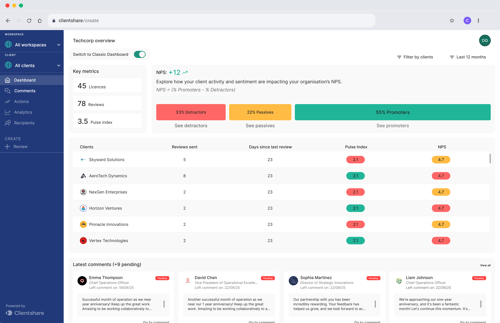
The Clientshare perspective
NPS remains a simple, familiar and valuable way to capture customer sentiment. But in complex B2B relationships, it shouldn't be used in isolation.
The best suppliers use NPS to strengthen their review process. They build the right feedback structure, deliver the insight through meaningful QBRs, measure it alongside commercial and operational indicators and act on the findings with clear ownership.
That is where NPS stops being a comfort metric and becomes a practical input to retention, growth and stronger customer relationships.